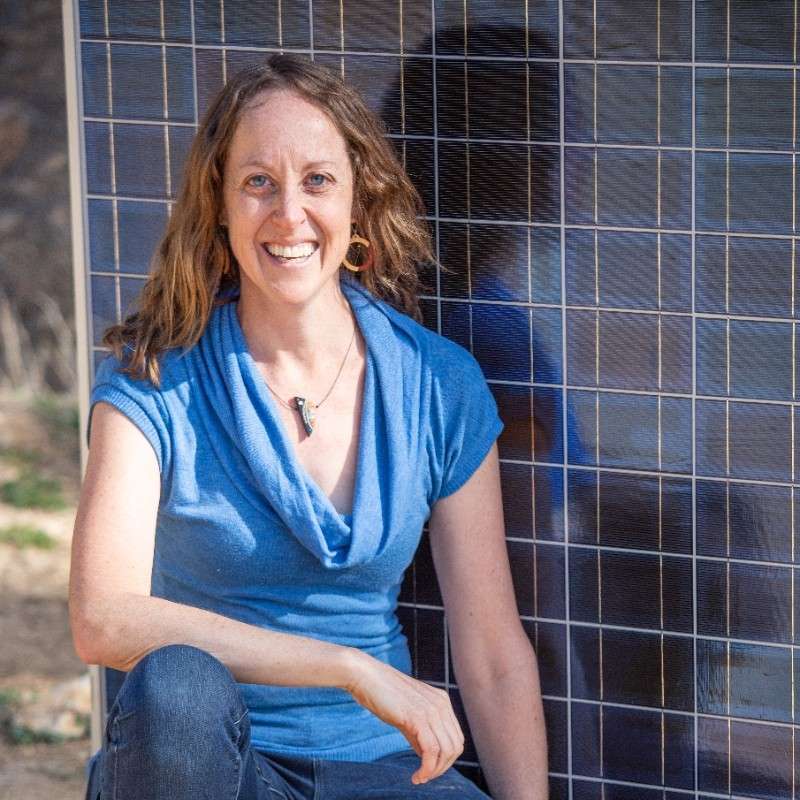
For Riley Neugebauer, the path to clean energy didn’t start with wires or watts—it began in the fields. A former farmer, food systems advocate, and sustainability coordinator in higher education, Riley now installs residential solar systems in Boulder, Colorado as part of the Namaste Solar team. While her resume spans over four decades, her latest role reflects a personal and professional culmination: doing work that directly addresses the climate crisis.
“I’m a liberal arts lady who has made a difference!” Riley shares, highlighting that her diverse background is a strength in an industry that often overlooks nontraditional pathways. She’s proof that clean energy careers are not just for engineers or electricians—they’re for anyone driven by purpose.
One of Riley’s proudest moments came recently when she passed the NABCEP PVIP Certification Exam—an advanced credential in the solar world. “There aren’t that many women installing solar,” she notes, “and I hope to see more.” Her achievement is not only personal; it’s symbolic of a broader shift toward inclusivity in a still male-dominated field.
Riley’s first exposure to renewables came during her undergraduate years at Allegheny College in Pennsylvania, where she began advocating for sustainable solutions. That early interest evolved over time, eventually leading her to complete a solar PV design and installation certificate program at San Juan College in New Mexico in 2007.
Having lived in different parts of Colorado, including the Four Corners region, Riley has seen firsthand the environmental costs of coal. But she’s also seen a hopeful counter-narrative taking shape.
“Clean energy is helping meet greenhouse gas reduction goals and helping all of us transition away from fossil fuels,” she says. “Seeing coal plants be phased out and retired, while solar is being installed at record rates is uplifting, particularly when clean energy development (in the place of fossil fuels) is happening on or right next to tribal lands where some of the worst environmental injustices are playing out.”
When asked what she wishes more people knew about her job, Riley doesn’t hesitate: “My job means that I have job security while also working towards improving the environment and addressing climate change. And I’m proof that women are definitely capable of becoming a solar installer!”
To Riley, clean energy careers offer a powerful alternative—not just technologically, but socially. “Congress should invest in clean energy jobs because it puts our public dollars into workers and infrastructure that reduces emissions instead of adding to them,” she argues. “It gives people hope, it cleans the air, and it provides options to marginalized and low-income communities who’ve been overlooked for so many generations.”
For Riley Neugebauer, clean energy is more than a job—it’s a calling. One that blends equity, environment, and empowerment. And she’s just getting started.