
For Emily Richardson, the path to clean energy leadership didn’t begin in a lab or a startup accelerator—it began with slotted floors and a policy problem.
Now at the Clean Energy Fund of the Carolinas (CEFC) — a green bank that serves North and South Carolina — Emily is working on starting a bill repayment program in the Carolinas. She was previously Residential Director at the Colorado Clean Energy Fund (CCEF) where she oversaw residential financing programs that support clean energy upgrades for homeowners across Colorado.
Her current role is a culmination of a long and intentional shift—from Capitol Hill to the Rocky Mountains, from national policy to local implementation.
Richardson didn’t always envision herself in energy. “In high school, I was completely convinced that I was going to become a doctor,” she admits, recounting her early pre-med path. But an appreciation for political science, combined with a deep appreciation for the natural world. catalyzed a change.
“My dad is an avid backpacker,” Emily explains, “As soon as my sister and I were old enough for him to justify taking us along, he said, ‘Okay, we’re going backpacking.’ He was really committed to making it a comfortable experience, so he carried this absurdly huge pack filled with brownies and all kinds of delicious food. Now that I have to carry my own gear, I look back and think—wow, what a saint.”
Her pivot to climate and energy was driven by a realization: “I could have an impact on people’s lives through climate policy,” she says. “And then I’ve just always been a really big outdoors person and cared a lot about wildlife and the environment. So it felt like a pretty natural switch.”
Richardson’s professional roots are in government, where she worked on Capitol Hill starting in 2015. One particularly memorable experience came while working for a North Carolina representative focused on the environmental and social impacts of hog waste. “North Carolina was the second-largest pork producer in the country and the way hog farms manage waste is pretty problematic. The hog houses have slatted floors, so all the waste falls through and gets flushed into these open-air pits called lagoons.”
Her involvement with this issue connected her with residents from all walks of life—”I visited our district and met a forward-thinking farmer who had capped his waste lagoons to capture methane for potential use as bioenergy. Researchers at NC State were also exploring ways to turn the waste into valuable byproducts like fertilizer. It was exciting to see farmers, clean tech professionals, and university researchers working together on innovative solutions.”
Later, while pursuing a master’s degree beginning in 2020, Richardson intentionally shifted away from broad policy and toward technical and business-focused clean energy coursework. “I felt like I had learned a lot of the policy stuff on the job,” she explains.
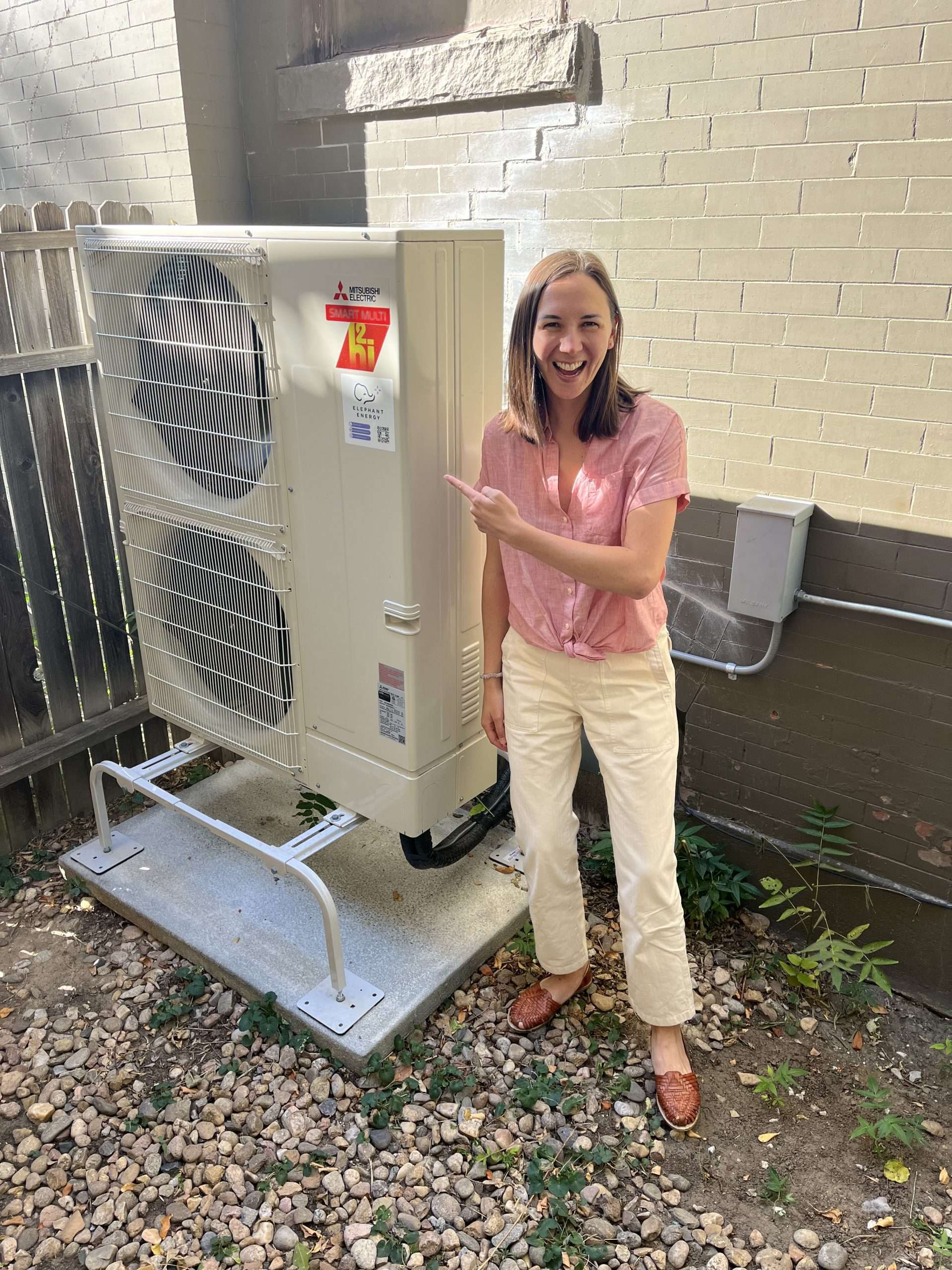
Since joining CCEF nearly three years ago, Richardson has focused on advancing electrification in rural communities through Electrify and Save—an innovative program that uses alternative underwriting to expand access to energy efficiency financing. “We partner with rural electric cooperatives across Colorado, Nebraska, Wyoming, and New Mexico,” she explains.
Though she lives in a metro area, Richardson is energized by the opportunity to serve under-resourced regions. “It’s been pretty fascinating to get more of a picture of what it looks like to try to push the energy transition outside of the metro area,” she says.
Asked about common misconceptions in clean energy, Richardson doesn’t point to the public—but to the workforce. “The myth-busting I have to do more frequently… is more around heat pump technology,” she explains. “You get a surprising amount of pushback from the workforce community that does installations.”
For many HVAC professionals, the shift toward heat pumps is daunting and resource-intensive. Richardson believes that tackling these challenges requires more than technical specs—it requires trust and storytelling. “Coming into this job, I thought it was all about reaching homeowners and consumers,” she says. “And then it completely became: Oh no, it’s all about reaching the workforce and contractors and community champions.”
From sleeping under the stars with her father to walking on a covered hog waste lagoon, Richardson’s journey reflects both the urgency and humanity behind the clean energy movement.