
Gregg Semler has never waited for markets to catch up—he’s built his career on seeing what’s next and going after it. A serial entrepreneur at heart, Semler has spent the last 25 years turning overlooked technologies into industry-shaping innovations. From fuel cells powering mobile phones to harvesting electricity from municipal water pipelines, his ventures are united by a common thread: a bold belief that clean energy can be reliable, scalable, low-cost, and abundant.
“I’ve been building energy and water companies since 2000,” Semler said. “My career has focused on commercializing innovative technologies in the clean tech space.”
The company he spun out, PolyFuel, broke ground as the first to demonstrate a working fuel cell powering a consumer device—his Nokia cell phone. “Fuel cells are a technology that’s been around for a long time… but nobody had ever seen one actually work at the consumer level,” Semler explained. PolyFuel eventually went public, cementing Semler’s reputation as an early clean energy innovator.
Fast forward to 2016, Semler founded InPipe Energy, building on his growing fascination with water infrastructure and its untapped potential for power generation. “Why are we covering the planet with solar panels and batteries,” he asked, “when pipelines exist that can produce energy on a much more predictable, consistent, reliable baseload basis?”
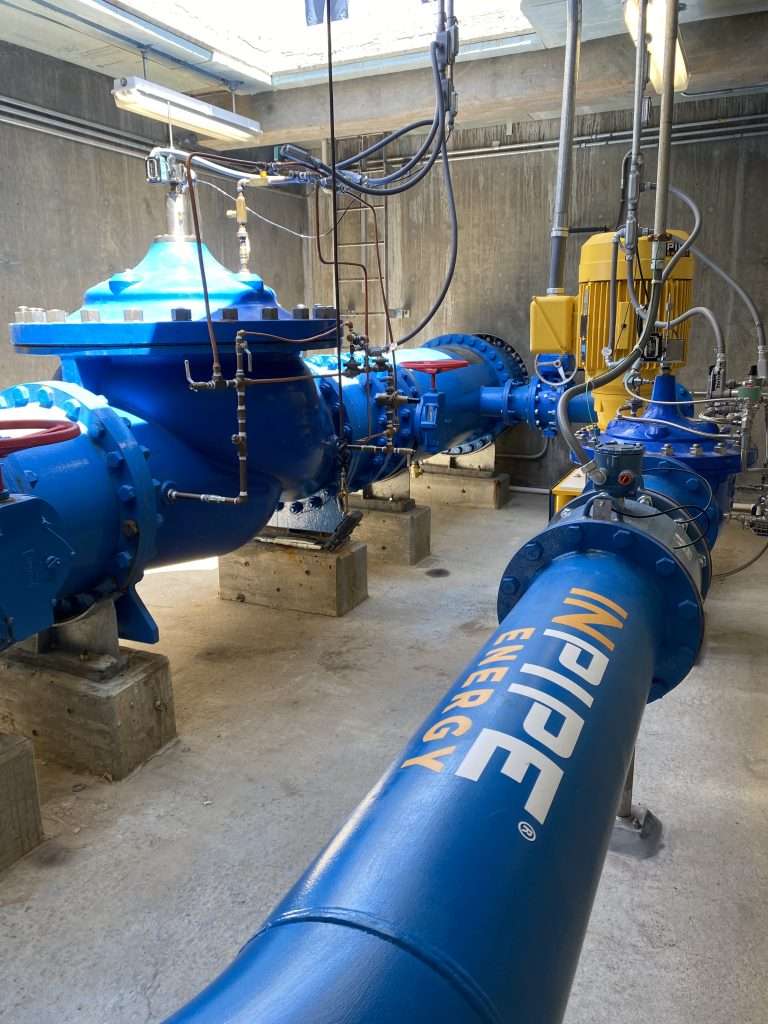
InPipe’s vision is to harvest kinetic energy from water moving through municipal pipelines. Unlike solar or wind, which are weather dependent, water flowing in pipelines is “energy that has no environmental impact,” he said. That’s no small claim in a sector where environmental trade-offs are routine.
The concept has proven viable through rigorous testing and pilot projects. “We spent the last 10 years building through the Department of Energy’s commercialization process,” said Semler, referencing the company’s flagship Aurora, Colorado project—InPipe’s fifth installed system.
Despite technological breakthroughs, Semler emphasized that growth is often stifled not by science, but by policy. “We really need a national standard and commitment to interconnection,” he said, pointing to the regulatory bottlenecks that make it difficult for new energy capacity to connect to the grid.
Permitting reform and clearer interconnection policies with funding could significantly accelerate deployment. As Semler noted, “The cost for energy is going to skyrocket if we don’t start adding new capacity faster onto the grid. InPipe has a proven technology that takes less than three weeks to install, but can take months or sometimes years to use because of bottlenecks interconnecting to the grid.”
Semler’s approach to energy recovery brings a unique value proposition to clean energy: it leverages existing infrastructure and provides continuous, low-cost power. “We produce electricity for about four or five cents a kilowatt hour,” he shared, “and the benefit of hydro is it produces electricity around the clock. It’s not intermittent—it’s continuous, baseload.”
This advantage makes it particularly attractive to industries like water utilities, agriculture, and mining, which are large energy consumers but often reluctant to prioritize energy projects. “Energy is often their second highest cost next to people,” Semler explained. “But they always prioritize water projects first.” Energy and water are becoming less affordable for Americans. That’s where incentives like the Inflation Reduction Act (IRA) come into play.
“Today, up to 50% of a HydroXS® project is reimbursable by the federal government,” Semler said. Thanks to these tax credits, project paybacks can shrink to two to three years—an appealing timeframe even for cautious utility managers.
Semler’s ambitions stretch far beyond U.S. borders. InPipe is now preparing to export its first HydroXS® system to Thailand. “This will prove we can export clean technology outside the U.S.,” Semler said. “No one in the world is doing what we’re doing… and we’ve proven it’s cost-effective and made in the U.S.”
For Semler, the clean energy movement is about more than just kilowatts—it’s a moral imperative. “We are killing off our planet through our dependence on carbon based fuels such as coal and natural gas,” he said. “It’s sad to see how habitats are changing and how people are being displaced by deforestation.”
Perhaps one of the most compelling insights from Semler is his focus on the often-overlooked nexus between water and energy. “Water utilities are the largest customers for electric utilities, but they rarely talk to each other,” he observed. This disconnect, he argues, is both a challenge and an opportunity. “We have to figure out a way to get water intensive industries to be more thoughtful about how they use energy.”
As Semler sees it, the future of clean energy depends not just on innovation but on integration across industries, technologies, and regulatory frameworks. “Why not use pipelines to generate energy and deliver water? What could be more sustainable?” With pioneers like him at the helm, the movement toward a more sustainable, inclusive, and practical energy future is gaining steam—quietly, predictably, and with the power of flowing water beneath our feet.
There’s never been a better time to consider an Energy Recovery System like the HydroXS®. With government funding now available and the continued push to develop novel solutions to battle the climate crisis, the time for water intensive industries like municipalities and agriculture to be more efficient, sustainable and resilient.
For information including funding options, please complete this form and an InPipe Energy specialist will contact you.