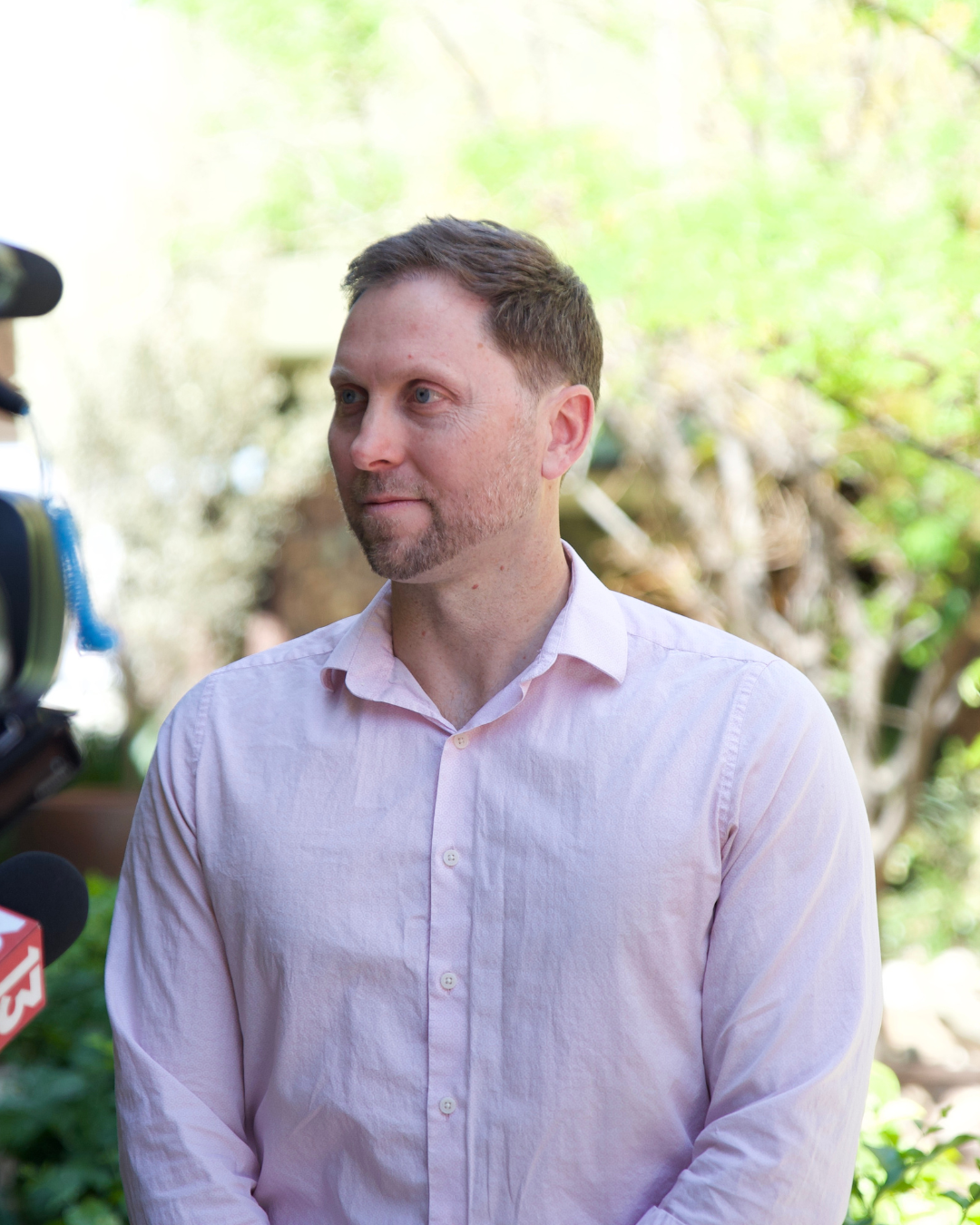
Robert Neifert has spent nearly a decade with Solar Gain, leading clean energy projects through cycles of policy shifts, market volatility, and a steadily growing public appetite for renewable solutions. A veteran voice in the field, Robert has weathered the solar industry’s most pivotal moments. Before joining Solar Gain, he worked at a commercial and residential solar company that was successful but also struggled with shifting policies and the instability of solar financing programs.
Robert’s passion for the environment runs deep. “I grew up in Pennsylvania running around in the woods, playing in streams, camping and having adventures in national parks,” he explains. Those early experiences fostered a lifelong commitment to protecting the natural world.
That commitment led him to pursue a degree in Environmental Studies from Antioch College in Ohio, entering the workforce at a time when clean energy was still a niche concern. “There wasn’t a solar industry 23 years ago. It was all about recycling and conservation,” he recalls. “The renewable energy transition has been really exciting to see throughout my career.”
His career began with retrofitting over 400 commercial buildings for energy efficiency — upgrading lighting, HVAC systems, and controls — before pivoting fully into solar as the industry matured and demand surged.
However, recent policy developments — such as the proposed Ways and Means bill — have cast a shadow over the industry’s progress.
“We can still do residential solar,” Robert says, “but only 10 or 20% of what we were doing. It’s pretty bad.”
Despite a decade of clean energy acceleration, Robert is deeply concerned about political resistance and policy rollbacks. He highlights the promise of the Inflation Reduction Act (IRA), which aimed to simplify incentives and accelerate electrification.
“Solar has already won. A majority of new energy generation is solar,” he explains. “The Inflation Reduction Act was so exciting because it capitalized on all the best ideas. If you wanted to buy a heat pump hot water heater, you could just get a rebate at the store instead of waiting for a tax credit.”
But that momentum has been stalled. Programs like Solar for All and state-led energy efficiency initiatives were just beginning to roll out when funding freezes and legal battles began. “The IRA was really just getting started but those funds are locked up in funding freezes and court battles now. So it’s really tragic.”
One of the ways Solar Gain has continued to make an impact is by focusing on low-income housing solar projects — an area where public policy and private innovation intersect meaningfully.
“We’ve done 15 projects across Arizona where a rundown apartment complex got a major remodel. We worked with public-private partnerships using tax credit incentives to build the housing, and solar tax credits to add solar,” Robert says. “You’re able to combine those into workable projects that the building owner can justify — and they couldn’t have done it without those public incentives.”
Robert’s decades-long journey through energy efficiency and solar power is a testament to perseverance in the face of uncertainty. From retrofitting commercial buildings to leading solar initiatives for affordable housing, he’s seen the clean energy industry evolve from a fringe movement to a mainstream force — only to now face new political and economic headwinds.
Yet, despite the setbacks, Robert remains driven by purpose.
“We’re just at the doorstep of a whole brave new world,” he says, describing the promise of electrification, battery storage, and distributed power.
His work is not just about technology—it’s about building a better, more equitable future. And while recent policy challenges have been discouraging, Robert’s story reminds us that progress is possible when vision, experience, and public support align.
As the clean energy transition hangs in the balance, Robert’s career offers both a warning and an inspiration: what we’ve built is worth protecting—and what lies ahead is still within reach.